REQUIRE A BESPOKE LOOK?
We offer a custom design
service at NO extra cost.

When planning sliding wardrobe doors, one of the first decisions you’ll face is the system they run on. The two main types are bottom roller and top hung sliding wardrobe doors—and while they may look similar, they perform very differently.
In reality, most modern made-to-measure sliding wardrobe doors use a bottom rolling system for one simple reason: it’s more stable, more practical, and better suited to real homes.
This guide explains how both systems work, the key differences, and which one is the right choice for your project.
| Feature | Bottom Roller | Top Hung |
|---|---|---|
| Weight support | Floor (bottom track) | Ceiling/top track |
| Stability | Excellent | Moderate |
| Suitable for heavy doors | Yes | Limited |
| DIY-friendly | Yes | Yes |
| Structural requirements | Minimal | High |
| Common in wardrobes | Yes | Rare |
Best overall choice for wardrobes: Bottom roller systems
Bottom roller systems are designed so the weight of each door is carried on the floor, using precision wheels that run inside a bottom track. The top track acts only as a guide to keep the doors aligned.
This is the system used across almost all modern wardrobe installations because it delivers:
If you're planning your layout, see our measuring guide to understand how your opening is prepared.
A solid, level floor is key—take time to check this before installing your bottom track.
Top hung systems suspend the doors from the top track, meaning the entire weight is carried by the ceiling or supporting structure above.
A small guide at the bottom prevents the door from swinging, but it does not carry weight.
This type of system is more commonly used for:
If your ceiling is plasterboard, additional structural support will almost always be required for a top hung system.
Walls, floors, and ceilings are rarely perfectly straight or level. Bottom rolling systems adapt far better to these conditions.
Made-to-measure sizing works hand-in-hand with bottom rolling systems to accommodate uneven openings.
Mirrored and glass sliding wardrobe doors are popular for good reason—but they are heavy. Bottom roller systems are designed to carry this weight safely.
Because the weight sits on the floor, there’s no need for reinforced ceilings or structural alterations.
See how it works step-by-step in our installation guide.
Most customers install bottom rolling systems themselves or use a local joiner—no specialist fitting required.
With gravity working in your favour (weight downwards, not suspended), bottom rolling systems maintain alignment and smooth operation for years.
There’s less strain on fixings, reducing the risk of long-term issues like sagging or misalignment.
For larger openings (3–5 door systems), bottom rolling is essential for consistent performance.
There are some situations where top hung systems can work:
However, these are usually niche applications—not typical fitted wardrobes.
If you’re planning full-height, multi-door wardrobes, top hung systems are rarely the best option.
Because bottom roller systems support heavier materials, they unlock far more design flexibility:
Browse our inspiration gallery for ideas.
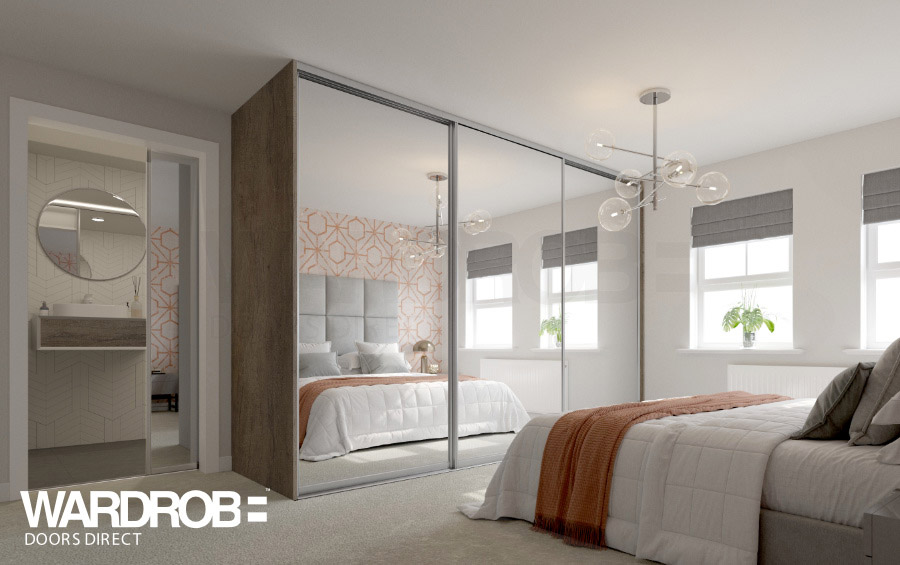
Mirrored sliding doors are one of the easiest ways to make a room feel larger and brighter.
Bottom roller = floor support
Top hung = ceiling support
Wider or taller doors benefit from bottom support
DIY installation strongly favours bottom rolling systems
Bottom rolling systems are more forgiving and durable
If you’re unsure, bottom roller systems are the safest and most versatile choice for almost every wardrobe project.
Accurate measuring is critical—follow our measuring guide before ordering.
For wardrobes, bottom roller systems are almost always better. They’re more stable, easier to install, and suitable for heavier doors.
Most do. Bottom tracks support the weight and ensure smooth, controlled movement.
Yes. Bottom roller systems are designed for DIY installation or fitting by a local tradesperson.
They can be used in some cases, but they’re generally less practical due to weight limits and structural requirements.
No. Modern tracks are slim, discreet, and available in finishes that match your doors.
While both systems exist, the reality is simple:
bottom roller sliding wardrobe doors are the best choice for almost all wardrobe applications.
They offer the right balance of strength, stability, ease of installation, and long-term reliability—making them ideal for made-to-measure designs in real homes.
Design your sliding wardrobe doors online today and create a solution tailored perfectly to your space.
Seeing finishes in your own space makes it easier to choose. You can:
Our guides are created by the Wardrobe Doors Direct design and technical team, specialists in made-to-measure sliding wardrobe doors and internal storage systems across the UK.
Call our team on 0800 035 1730.


We offer a custom design
service at NO extra cost.
Follow these simple guidelines to
get the perfect fit for your sliding
wardrobe doors.
The sliding wardrobe doors are
very easy to install so you don’t
have to be a DIY expert.
Request FREE samples to help
with the design process and
colour matching.