REQUIRE A BESPOKE LOOK?
We offer a custom design
service at NO extra cost.

Installing made-to-measure sliding wardrobe doors wall-to-wall and floor-to-ceiling can create a clean, fitted appearance that maximises bedroom storage while giving the room a more bespoke look. However, many wardrobe openings are not perfectly straight, plumb or level, which can make direct installation onto the walls, floor or ceiling more difficult.
Sliding wardrobe door framing kits help create a straight, level and professionally finished opening for the wardrobe tracks and doors to be fitted against. They can also help compensate for uneven walls, sloping floors and irregular ceilings while improving the overall finish around the wardrobe opening.
This guide explains how sliding wardrobe door framing kits work, when they are useful, the different framing components available, and the practical considerations when preparing an opening for sliding wardrobe doors.
A sliding wardrobe door framing kit is commonly recommended when:
Typical framing kit components include:
These components help create straighter fixing surfaces for the sliding wardrobe door tracks while improving the finished appearance around the wardrobe opening.
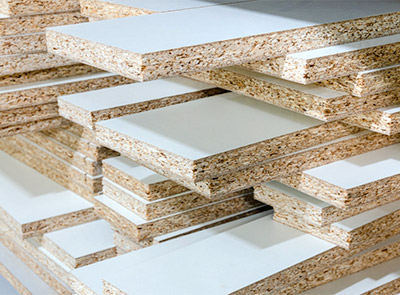
A sliding wardrobe door framing kit is typically made from melamine-faced chipboard (MFC) and is designed to create a straight and level opening for sliding wardrobe doors.
The main components are:
These framing components provide suitable fixing surfaces for the wardrobe tracks while helping create a cleaner transition between the wardrobe and the surrounding room.
Wardrobe framing can be constructed using planed timber or softwood before being painted, stained or finished on site. However, many customers prefer MFC framing kits because they provide a cleaner and more colour-coordinated finish.
Advantages:
Considerations:
Advantages:
MFC framing kits are available in a range of colours and finishes to coordinate with sliding wardrobe doors, interiors and room décor.
Related guide:
What is melamine-faced chipboard?
White framing kits often work well because they coordinate naturally with skirting boards, ceilings, architraves and many wardrobe styles.
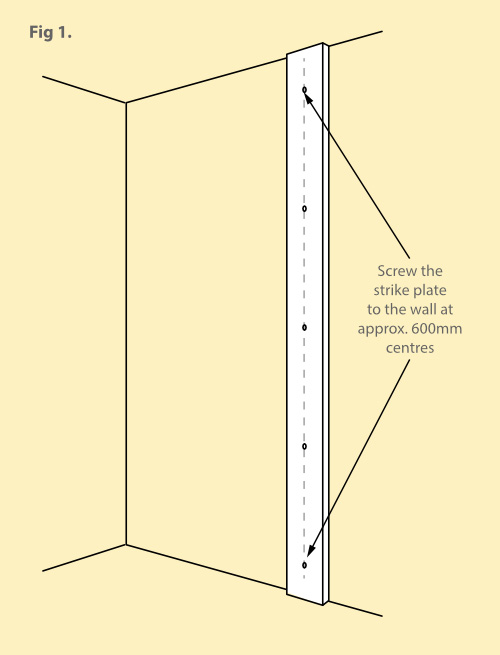
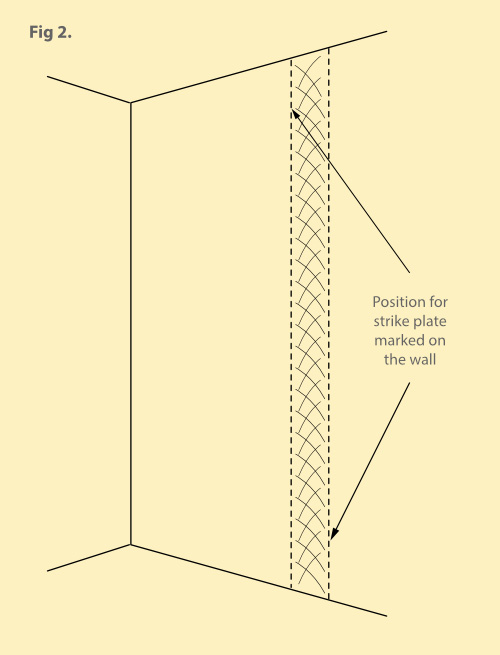
Strike plates are vertical framing panels fitted to the side walls of the wardrobe opening. They create a straight closing surface for the sliding wardrobe doors while also acting as a protective ‘buffer’ between the doors and the surrounding walls.
Without strike plates, the leading edge of the sliding wardrobe door may come into direct contact with plaster, wallpaper, paintwork or the metal door stile itself. Over time this repeated contact can damage both the wall finish and the door edge.
Liners are horizontal framing panels fitted to the floor and ceiling to create level fixing surfaces for the sliding wardrobe door tracks.
Typical strike plate and liner dimensions:
| Component | Length | Width | Thickness |
|---|---|---|---|
| Strike plates / liners | 2800mm | 87mm | 18mm |
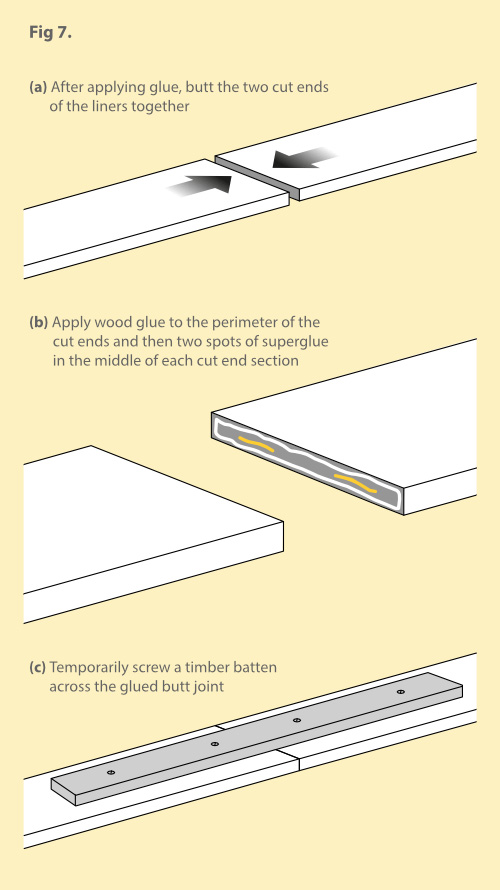
Framing kits are also available for wider openings. A 5600mm width kit is supplied as 2 x 2800mm liners, which are cut and butt-jointed together to suit the overall aperture width.
Floor liners are especially useful if you are fitting directly onto carpet or fitting carpet afterwards, because they provide a straight edge for the carpet fitter to work up to.
If there is already an existing wardrobe framework in place and it will remain as part of the installation, measurements should be taken from framework-to-framework.
In this situation, you do not normally require a new framing kit because the existing framework already defines the finished wardrobe opening.
However, if there is no existing framework and you are ordering strike plates and liners with your sliding wardrobe doors, measurements should be taken from wall-to-wall and floor-to-ceiling.
You do not need to deduct the framing thickness yourself.
If strike plates and liners are included in your order, we will automatically deduct:
This accounts for the thickness of the strike plates and liners.
If you are ordering strike plates and liners, the framing kit must be installed before fitting the tracks and doors because the wardrobe doors will be manufactured to suit the framed opening.
Related guide:
Sliding wardrobe door measuring guide
Flooring height can affect the finished wardrobe opening size, so measurements should always be taken from the correct floor level.
If installing directly onto carpet:
If carpet or flooring will be fitted afterwards:
Floor liners are recommended when fitting onto carpet or carpeting afterwards because they:
Related guide:
Should sliding wardrobe doors be fitted before carpet or flooring?
Sliding wardrobe door measuring guide.
Decide whether flooring will be fitted before or after the wardrobe installation before taking final measurements.
If the wardrobe is not being installed wall-to-wall, you may require one or more wardrobe end panels.
This commonly applies to:
Typical end panel dimensions:
| Component | Length | Width | Thickness |
|---|---|---|---|
| End panel | 2800mm | 640mm / 900mm | 18mm |
In a wall-to-end-panel installation, a strike plate is normally only required on the wall side. The wardrobe end panel itself provides the closing surface on the opposite side.
Related guide:
How to install a wardrobe end panel
One of the most common installation questions is whether skirting boards or ceiling coving need to be removed.
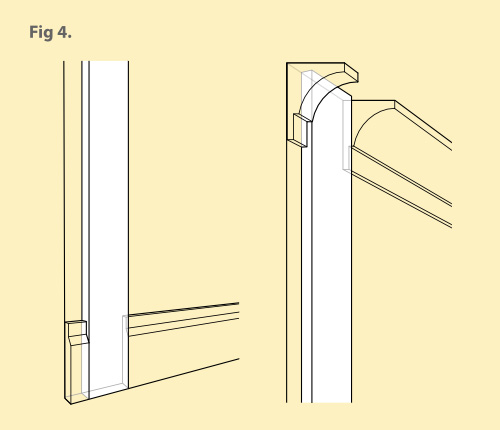
This generally creates the neatest finished result because the strike plates can sit flush against the wall.
Related guide:
How to remove skirting board sections for sliding wardrobe framing
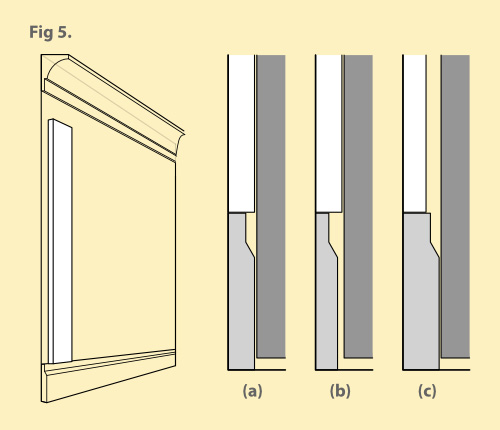
This may work if the skirting projection closely matches the framing thickness. However, mismatched depths can leave visible gaps or prevent the doors from closing neatly against the strike plate.
For example, if the skirting projects further than the 18mm strike plate thickness, the door may never fully contact the strike plate itself. Alternatively, if the strike plate projects further than the skirting, a visible gap can appear near the bottom corner of the door.
Removing sections of skirting board usually creates a cleaner and more professional finished appearance than trying to work around deep mouldings.
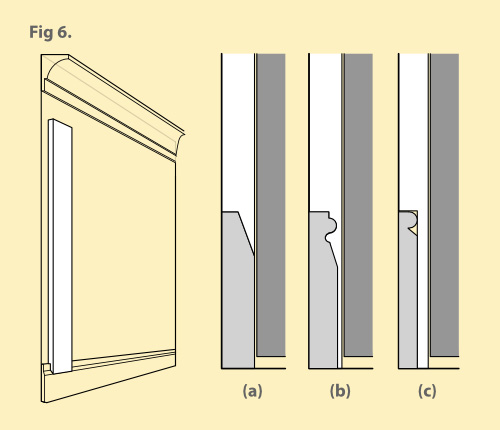
Strike plates or wardrobe end panels can sometimes be cut and scribed around skirting boards, coving or uneven wall surfaces.
This approach is particularly useful in older homes where decorative mouldings are being retained.
Related guide:
How to scribe wardrobe panels around skirting boards and uneven walls
Most rooms are not perfectly square, especially in older properties, loft rooms and alcoves. Sliding wardrobe door framing kits help compensate for these imperfections and create straighter fixing surfaces for the tracks and doors.
If walls are bowed, twisted or out of plumb, strike plates can be packed away from the wall to create a straighter vertical closing surface.
Packers can be positioned behind the strike plates at fixing points to compensate for uneven plaster or bowed wall surfaces.
For more severe irregularities, additional framing or scribed infill sections may be required.
Related guide:
How to fit sliding wardrobe doors to uneven walls
Floor liners can be packed or levelled before the bottom track is installed.
Related guide:
How to install sliding wardrobe doors on a sloping floor
Ceiling liners help create a level fixing point for the top track.
If the ceiling varies significantly, an infill panel or lightweight bulkhead can help create a cleaner and straighter visual line above the wardrobe.
Related guide:
How to fit infill panels above sliding wardrobe doors
Always check the opening with a long spirit level before taking final measurements.
Strike plates are commonly fixed using either:
Screw fixing usually provides the strongest mechanical fixing but may leave visible screw caps depending on the installation method used.
Grab adhesive can create a cleaner finished appearance because no visible fixings are required on the face of the strike plate. It can also be useful where fixing directly into plasterboard or difficult wall surfaces.
To fix the ceiling liner, it can be drilled and screwed into the ceiling or fixed using a strong grab adhesive, depending on the ceiling construction and fixing points available.
As the top track is only a guide track and not load bearing, adhesive fixing methods are often suitable where ceiling joists cannot easily be located.
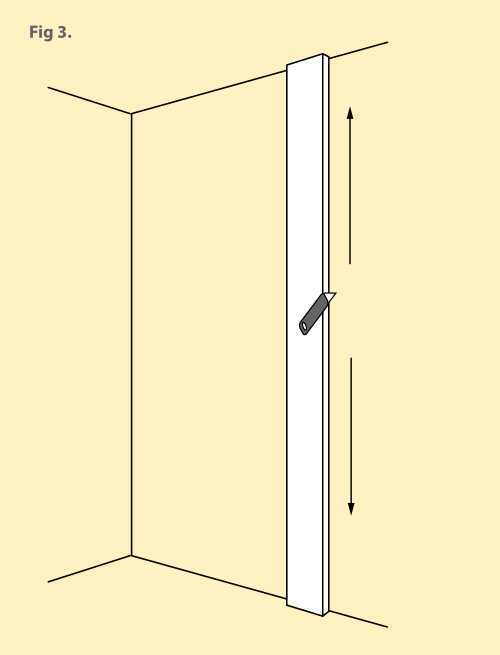
If using grab adhesive, ensure the wall surface is clean, dry and stable before fixing the strike plates or liners. Excess adhesive squeeze-out can also be used as a gap filler. Allow the adhesive to dry fully before trimming neatly with a flat blade.
If the wardrobe opening exceeds 2800mm wide, multiple liners may need to be joined together.
The panels are typically:
Because a butt joint is not a fully structural joint on its own, additional temporary support may be required until the liner is fixed into position.
Once the tracks are installed, the joints are generally far less noticeable.
Related guide:
How to cut melamine wardrobe panels without chipping
Coming soon:
To help minimise chipping when cutting melamine-faced chipboard, apply masking tape over the cut area, mark the cut line with pencil and carefully score along the line with a sharp blade before cutting.
It is important to distinguish between:
This article focuses on the structural preparation of the wardrobe opening itself.
Decorative architraves and visible outer framing are covered separately here:
Sliding wardrobe door frames and architrave ideas
Structural framing helps the wardrobe function correctly, while decorative framing helps complete the finished appearance visually.
If the framework already exists and will remain, measure from framework-to-framework.
If there is no framework and strike plates and liners are being ordered, measure wall-to-wall and floor-to-ceiling.
Wardrobe Doors Direct will automatically deduct the framing thickness.
Fixing tracks directly onto soft carpet can affect long-term alignment and performance.
Floor liners provide a more stable fixing surface.
Many walls appear straight visually but vary significantly when checked with a spirit level.
Always measure:
In many cases, removing sections of skirting board creates a neater and easier installation.
Not always. However, framing kits are recommended when the walls, floor or ceiling are uneven or unsuitable for direct fixing.
Strike plates provide a vertical closing surface for the sliding wardrobe doors while protecting walls and plasterwork from repeated door contact.
They can, but floor liners are generally recommended because they create a more stable fixing surface and provide a straight edge for carpet fitting.
No. If strike plates and liners are included in your order, Wardrobe Doors Direct will automatically deduct the necessary allowances from the wardrobe door sizes.
No. In a wall-to-end-panel installation, the wardrobe end panel itself normally acts as the closing surface.
Yes. Strike plates, liners and packers can help create straighter fixing surfaces when walls or floors are uneven.
Preparing the wardrobe opening correctly is one of the most important parts of a successful sliding wardrobe installation. Framing kits help create straighter fixing surfaces, improve track installation, compensate for uneven rooms and provide a cleaner finished appearance.
Whether you are fitting wall-to-wall sliding wardrobe doors, installing wardrobes into an alcove or creating a bespoke floor-to-ceiling storage solution, careful framing preparation can improve both the appearance and long-term performance of the wardrobe system.
Design your sliding wardrobe doors online today.
Seeing finishes in your own space makes it easier to choose. You can:
Our guides are written by the Wardrobe Doors Direct design and technical team, specialists in made-to-measure sliding wardrobe doors across the UK.
Call our team on 0800 035 1730.

We offer a custom design
service at NO extra cost.
Follow these simple guidelines to
get the perfect fit for your sliding
wardrobe doors.
The sliding wardrobe doors are
very easy to install so you don’t
have to be a DIY expert.
Request FREE samples to help
with the design process and
colour matching.