
REQUIRE A BESPOKE LOOK?
We offer a custom design
service at NO extra cost.

Corner wardrobes are one of the most effective ways to make use of otherwise wasted space in a bedroom. By extending storage across two adjoining walls, an L-shaped wardrobe can provide significantly more storage than a standard straight wardrobe while maintaining a clean, fitted appearance.
Using made-to-measure sliding wardrobe doors makes these installations particularly practical because the doors slide sideways rather than opening into the room. This helps maximise floor space, improves accessibility and allows storage to fit neatly into challenging room layouts.
Whether you're planning storage for a small bedroom corner, a guest room or a larger master bedroom, a made-to-measure solution can be tailored to suit your room dimensions and storage requirements.
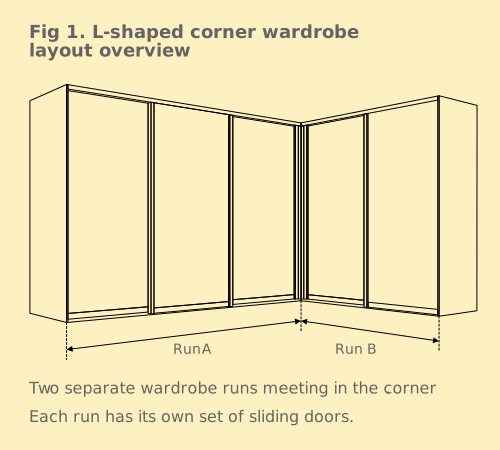
A corner wardrobe is a storage solution that wraps around a room corner using two separate wardrobe runs.
Often referred to as an L-shaped wardrobe, this layout uses space that would otherwise remain unused and can significantly increase storage capacity without making the room feel crowded.
Most installations use two independent sets of sliding doors positioned on adjoining walls. Each set operates separately, allowing easy access to clothing and storage while creating a seamless fitted appearance.
Mirrored sliding wardrobe doors can help smaller bedrooms feel brighter and more spacious while increasing the practical value of the wardrobe.
Traditional hinged doors can be difficult to use in corner layouts because they require clearance space when opened.
Sliding doors eliminate this issue entirely by moving sideways along a track system.
Benefits include:
For many room layouts, sliding wardrobe doors make a corner installation far more practical than traditional fitted wardrobes.
Sliding doors are particularly beneficial in box rooms and guest bedrooms where every centimetre of space counts.
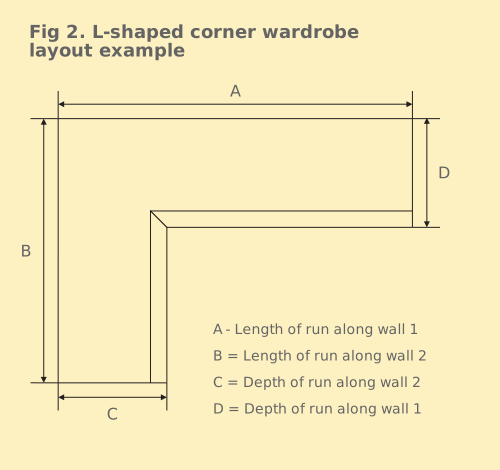
Before ordering, create a simple sketch showing:
This helps establish where the two wardrobe runs will meet and whether any room features may affect the design.
Although most L-shaped wardrobes are installed at 90 degrees, other angles can often be accommodated depending on the room layout.
Include photographs of the room when seeking design advice. Images often reveal details that measurements alone can miss.
For help taking measurements, see our Measuring Guide for Sliding Wardrobe Doors.
For comfortable clothing storage, we generally recommend planning for a wardrobe depth of approximately 640mm.
This provides adequate clearance for:
While the sliding door system itself only requires a minimum depth of approximately 87mm, a finished wardrobe depth of around 640mm typically provides the best balance between storage capacity and usability.
If you regularly store bulky coats or jackets, allowing slightly more depth can improve day-to-day practicality.
When designing a corner wardrobe, it is important to consider the internal storage at the same time as the door layout.
Hanging rails, shelving, drawers and corner storage solutions all affect how practical the finished wardrobe will be.
Most made-to-measure installations work best when the doors and wardrobe interiors are planned together rather than as separate projects.
One of the biggest advantages of a corner wardrobe is the amount of storage it can provide. However, the deepest part of the corner requires careful planning to ensure it remains practical and accessible.
With the right layout, this area can become some of the most useful storage space in the room
Corner Shelving
Items that are not needed every day, such as seasonal clothing, spare bedding, luggage or storage boxes, can be placed towards the back while frequently used items remain closer to the front.
Reserve the deepest corner shelves for occasional-use items rather than everyday clothing.
Traditional straight hanging rails can present a challenge because the rails often meet at 90 degrees.
This means clothes hanging towards the back corner can be harder to see and access, particularly where garments overlap between the two wardrobe sections.
Careful planning can minimise these issues, but it is worth considering how the wardrobe will be used before finalising the interior layout.
Curved hanging rails are a popular solution because they improve access to hanging clothes around the corner.
Rather than meeting at a sharp angle, the rail follows a smooth curve, making it easier to move garments around the corner and view stored clothing.
The trade-off is that clothes naturally gather towards the front of the curve, which can leave some unused space towards the back.
For many homeowners, however, the improved accessibility outweighs this small reduction in storage efficiency.
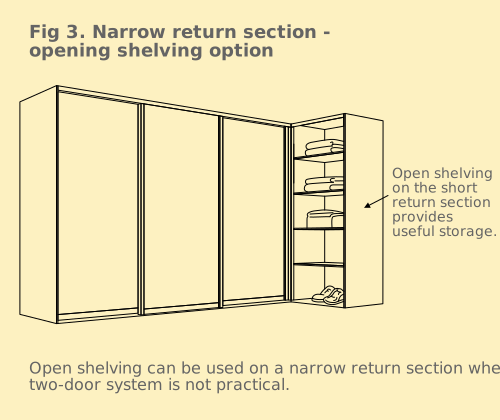
In some L-shaped wardrobe layouts, one side of the wardrobe may be relatively short.
Where there is sufficient width, the shorter section can often be fitted with a conventional two-door sliding wardrobe system on a double track.
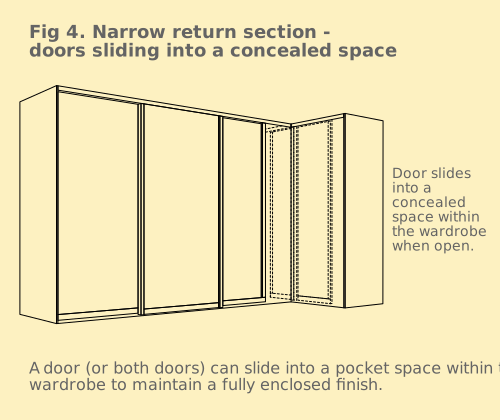
However, if the return section is particularly narrow, a standard two-door arrangement may become impractical because the individual door widths become too small.
There are two common approaches to solving this issue.
Open shelving can be used on the shorter return section while sliding doors are installed on the main wardrobe run.
This provides useful storage for folded clothes, shoes or accessories.
However, many homeowners prefer fully enclosed storage rather than visible shelving.
With careful planning, the shorter section can sometimes be designed so that a single sliding door, or both doors of a two-door system, slide into a concealed space within the wardrobe interior when opened.
This allows access to the narrow storage section while maintaining a fully enclosed design.
The principle is similar to pocket sliding door systems, although the exact arrangement will depend on the wardrobe dimensions and internal layout.
When planning a narrow return section, consider both the minimum practical door width and the storage requirements. A small adjustment to the layout can often create a much more usable design.
The installation method differs depending on the frame system selected.
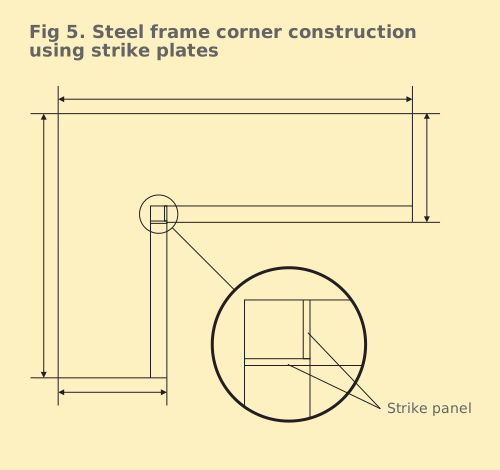
Steel-framed sliding wardrobe doors typically require a structural pillar where the two wardrobe runs meet.
This pillar is often formed using two strike plates fixed together to create an L-shaped column, although a strike plate and end panel combination can also be used depending on the installation.
While this creates a cost-effective solution, it can slightly reduce access to the deepest part of the corner.
Steel-framed installations are often suitable for:
If the wardrobe will only be used occasionally, a steel-framed installation can provide excellent value.
Aluminium-framed sliding wardrobe doors offer a more streamlined solution.
The top and bottom tracks can be mitred to suit the required angle, allowing the wardrobe runs to meet neatly at the corner without the need for a structural pillar.
This creates:
For everyday use, aluminium-framed systems are often the preferred option.
If maximising usability is important, aluminium-framed sliding wardrobe doors usually provide the best solution.
Yes. Corner wardrobes make use of otherwise wasted space and can provide substantially more storage than a standard straight wardrobe.
They are essentially the same concept. An L-shaped wardrobe is simply a corner wardrobe that extends along two adjoining walls
Yes. Most installations use two independent sets of sliding wardrobe doors installed on adjoining walls
No. While most are designed around a 90-degree corner, other angles can often be accommodated.
A wardrobe depth of approximately 640mm is generally recommended for comfortable clothing storage.
Aluminium-framed systems usually provide better access and greater usability, while steel-framed systems can offer a more economical soluti
A corner wardrobe is one of the most effective ways to transform unused space into practical storage. With made-to-measure sliding wardrobe doors, you can create a fitted solution tailored to your room dimensions, preferred finishes and storage requirements.
For further inspiration, explore our guides to alcove storage solutions, narrow wardrobes, floor-to-ceiling wardrobes, angled sliding wardrobe doors and triple track sliding wardrobe doors.
You may also find our Installation Guide for Sliding Wardrobe Doors useful if you're planning a DIY installation.
Design your made-to-measure sliding wardrobe doors online today.
Seeing finishes in your own space makes it easier to choose. You can:
Our guides are written by the Wardrobe Doors Direct design and technical team, specialists in made-to-measure sliding wardrobe doors across the UK.
Call our team on 0800 035 1730.


We offer a custom design
service at NO extra cost.
Follow these simple guidelines to
get the perfect fit for your sliding
wardrobe doors.
The sliding wardrobe doors are
very easy to install so you don’t
have to be a DIY expert.
Request FREE samples to help
with the design process and
colour matching.